
Electronic Recycling Center Near Me: Drop-Off Hours, Fees & Accepted Items
Use this practical e-waste guide before taking a TV, laptop, phone, computer, monitor, printer, tablet, lithium battery, charger, cable or small appliance to a recycling center. It explains how to find a real drop-off option, how to verify hours, what may cost money, what gets rejected, and what to do before you hand over a data-bearing device.
Quick Answer: Where Should You Take Old Electronics?
An electronic recycling center near you may be a city or county e-waste site, a household hazardous waste facility, a certified electronics recycler, a manufacturer take-back program, a retail recycling counter, a nonprofit refurbisher, or a one-day collection event. Do not assume every recycling center accepts electronics.
The fastest safe process is: identify your item, check if it can be donated or reused, erase personal data, remove batteries only when safe, verify accepted items and fees, confirm today’s hours, and call before bringing TVs, CRT monitors, business loads, damaged batteries or large quantities.
EPA Screenshot Reference: What to Check Before You Drop Off Electronics
This screenshot is placed near the first action step because it helps users recognize the official EPA guidance path before choosing a local facility. It is a user-help visual reference only; it is not a live-status claim for any local center’s hours, fees or accepted items.
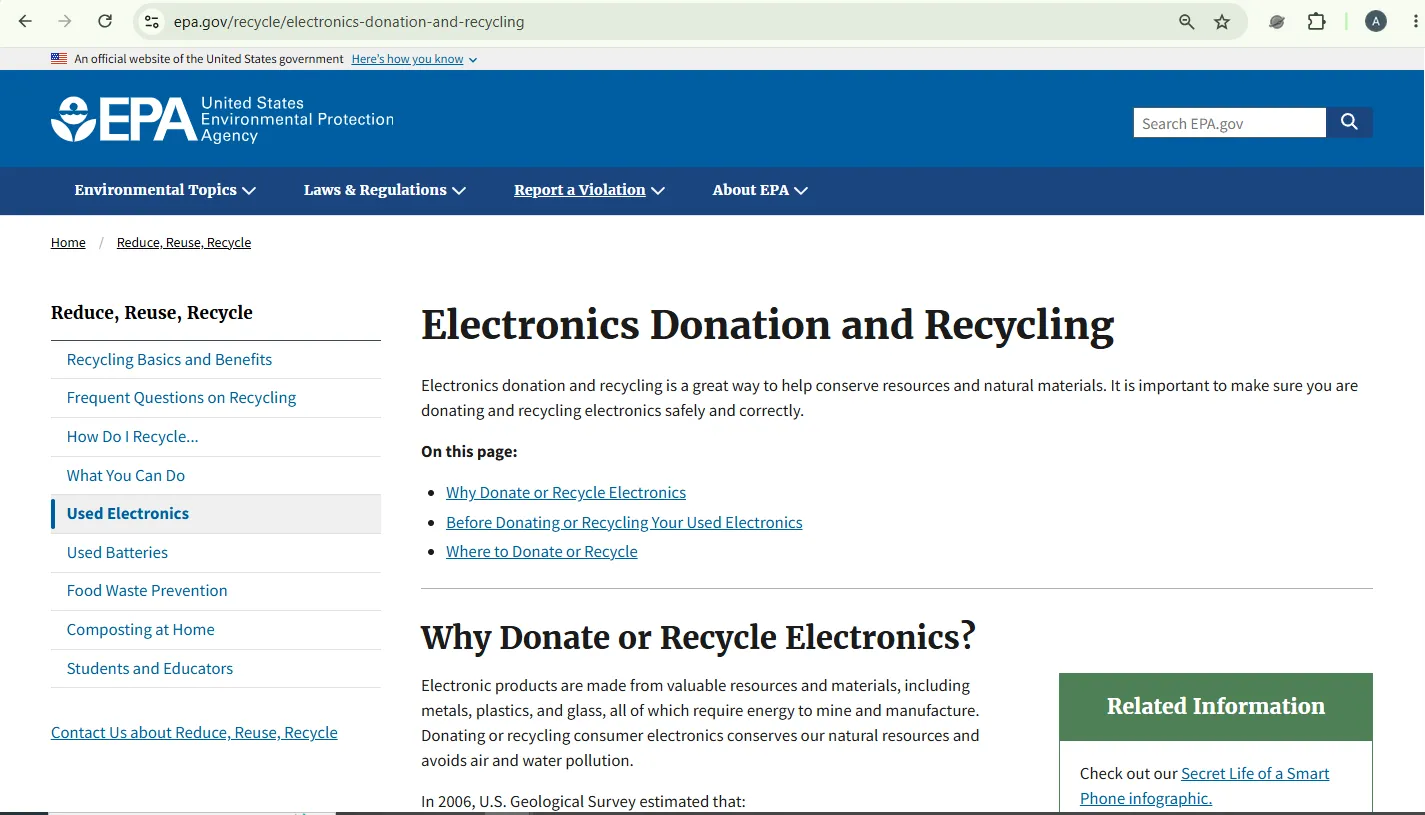
Use the screenshot as a reminder of the safe sequence: consider reuse first, delete personal information, remove batteries when appropriate, and check your state or community recycling options before visiting a drop-off site.
On This Page
- How to find a nearby electronic recycling center
- Open today, open now and weekend hours
- Accepted electronic items
- Items that may be rejected
- Free vs paid e-waste recycling
- Data wiping before recycling
- Lithium battery safety
- TV, monitor and CRT recycling
- R2 and e-Stewards certified recyclers
- Retail, manufacturer and local options
- Business and bulk electronics
- Common rejected-load mistakes
- Map search
- FAQ
How to Find an Electronic Recycling Center Near You
Search by the item, not only by the phrase “recycling center near me.” A facility that accepts laptops may reject TVs. A retailer that accepts phones may reject CRT monitors. A county facility may accept e-waste only during specific event hours. The better search is “TV recycling near me,” “computer recycling near me,” “laptop recycling near me,” “monitor recycling near me,” or “phone recycling near me.”
- Start with your city or county solid waste page. Local government pages often list resident eligibility, event dates, proof-of-residency rules, appointment requirements and item limits.
- Check the exact item. Confirm whether the site accepts your TV, monitor, computer, printer, phone, battery device, cable box, speaker, small appliance or office equipment.
- Verify hours for the electronics program itself. A building may be open while the e-waste counter or special event is closed.
- Call before bringing problem items. Call first for CRT screens, broken screens, swollen batteries, large TVs, business loads, servers, medical devices and bulk quantities.
Electronic Recycling Center Hours: Open Today, Open Now and Weekend Checks
Electronic recycling hours are often narrower than regular store or transfer-station hours. A city e-waste facility may open only one or two days a week. A household hazardous waste site may require an appointment. A retail counter may follow store hours but still limit electronics. A one-day event may end early when trucks fill.
| User Need | What It Really Means | Best Action |
|---|---|---|
| Open today | You need same-day drop-off, but many e-waste programs have limited schedules. | Check the facility page, then call if your item is heavy, battery-powered or fee-based. |
| Open now | Map hours may show the store or building open, not the e-waste program. | Confirm the electronics drop-off counter, event lane or HHW desk is operating now. |
| Saturday drop-off | Many users need weekend access for TVs, computers and home cleanouts. | Look for city events, county HHW hours, retail programs and certified recyclers with Saturday hours. |
| Holiday schedule | Public facilities, transfer stations and special events may close or change hours. | Use the official city, county, retailer or recycler page before loading the car. |
Accepted Items at Electronic Recycling Centers
Accepted items vary by program, but many e-waste centers accept common household electronics, data devices, display screens, computer accessories, cords and small electronics. The word “electronics” is broad, so never rely on the category alone.
| Item Type | Often Accepted | Verify First |
|---|---|---|
| Computers and laptops | Desktop towers, laptops, hard drives, keyboards, mice, docking stations and cables. | Ask whether hard drives are accepted, wiped, shredded, returned or documented. |
| Phones and tablets | Smartphones, tablets, chargers, cases and accessories. | Remove SIM cards, memory cards and personal data before drop-off. |
| TVs and monitors | Flat-screen TVs, flat-panel monitors and sometimes CRT displays. | Check size limits, CRT rules, item limits and fees. |
| Printers and office electronics | Printers, scanners, fax machines, routers and small office equipment. | Remove paper, toner or cartridges if the facility requires it. |
| Small electronics | Cameras, game consoles, radios, remotes, DVD players, speakers, headphones and cords. | Box small items so they do not scatter in your vehicle. |
| Battery-powered devices | Some programs accept devices with built-in rechargeable batteries. | Ask how to handle lithium, removable, damaged or swollen batteries. |
Items That May Be Rejected or Sent Somewhere Else
Many users get rejected because they bring “anything with a cord” to the wrong program. Some e-waste sites reject refrigerators, freezers, air conditioners, dehumidifiers, smoke detectors, medical equipment, loose toner, leaking batteries, broken CRT glass, appliances with refrigerant, business bulk loads or recalled products.
Electronic Recycling Fees: Free Drop-Off vs Paid Items
Some electronics drop-off programs are free for residents, while others charge for TVs, CRT monitors, large screens, hard-drive destruction, pickup, business loads or items above a daily limit. Retail and private network collection locations may charge fees, and some programs charge specifically for desktop monitors or televisions.
| Possible Fee | Why It Happens | Ask Before You Go |
|---|---|---|
| TV fee | Large screens and older TV materials can be costly to process. | Ask for screen-size limits and per-TV charges. |
| CRT monitor fee | Older CRT glass often requires special handling. | Ask whether CRT and flat-panel monitors have different rules. |
| Hard-drive destruction fee | Secure data destruction is not the same as basic recycling. | Ask whether they wipe, shred, certify or simply recycle drives. |
| Pickup fee | Home, office or heavy-item pickup requires labor and transport. | Compare drop-off, mail-in and pickup options. |
| Business load fee | Commercial electronics are not always covered by free resident programs. | Request a quote and documentation before sending bulk equipment. |
Data-Wiping Checklist Before Recycling Electronics
EPA advises users to delete personal information before donating or recycling electronics. This matters because computers, phones, tablets, printers, cameras, smart devices and storage drives can hold photos, passwords, contacts, financial records, location data and account access.
- Back up files first. Save photos, documents, contacts, software keys and account recovery information before erasing a device.
- Sign out of accounts. Sign out of Apple, Google, Microsoft, Samsung, cloud storage, device tracking and payment apps.
- Remove removable storage. Take out SIM cards, SD cards, USB drives, camera cards, discs and external drives.
- Factory reset the device. Use the official reset process. For sensitive computers, consider a full-drive wipe or physical drive removal.
- Ask about drive handling. If you need proof, use a recycler that offers documented data destruction, serial tracking or drive shredding.
Lithium Battery and Rechargeable Battery Rules
Lithium-ion batteries and devices containing them should not go into household garbage or regular recycling bins. EPA says they should go to separate recycling or household hazardous waste collection points, and battery terminals should be taped or batteries placed in separate bags to help prevent fires.
| Battery Situation | Risk | Practical Step |
|---|---|---|
| Removable rechargeable battery | May need separate battery recycling. | Remove only if designed to be removed safely, then follow local battery drop-off rules. |
| Built-in lithium battery | Can create fire risk if crushed or punctured. | Keep the device intact and ask whether the e-waste site accepts battery-containing devices. |
| Loose lithium battery | Terminals can spark if they touch metal or other batteries. | Tape terminals with non-metallic tape or bag batteries individually when directed. |
| Swollen or damaged battery | Higher fire and safety risk. | Do not place it in trash or curbside recycling. Contact household hazardous waste or battery program staff first. |
TV, Monitor and CRT Recycling Near Me
TV recycling is one of the highest-risk “near me” intents because fees, size limits and CRT rules vary widely. Flat-screen TVs may be accepted at some retail or municipal programs. Older CRT TVs and CRT monitors often need special handling and may cost more.
Certified Electronics Recyclers: When R2 or e-Stewards Matters
For sensitive devices, business electronics, bulk equipment, hard drives, servers or high-value electronics, use a certified electronics recycler when possible. EPA identifies R2 and e-Stewards as accredited certification standards and notes that certified recycler programs may include services such as data security and asset management.
Retail, Manufacturer, Mail-In and Local Government Options
Search results often show retailer recycling pages, city e-waste pages, manufacturer take-back programs and private recyclers together. These are not the same. A retail counter may be convenient for small household items but may have item limits. A city or county event may be best for residents. A manufacturer program may be better for brand-specific take-back. A certified recycler may be best for business and data-bearing devices.
| Option | Best For | Watch For |
|---|---|---|
| City or county e-waste site | Resident electronics, HHW-linked events, local disposal rules. | Proof of residency, appointment windows, holiday closures and item limits. |
| Retail recycling counter | Small electronics, accessories, phones, some computers and limited TVs. | Per-day item limits, health/safety exclusions and possible fees. |
| Manufacturer take-back | Brand-specific devices, mail-in options or trade-in value. | Shipping rules, device condition, data wiping and model eligibility. |
| Certified recycler | Data-bearing devices, business loads, asset tracking and secure destruction. | Quote, appointment, certificate, downstream handling and pickup terms. |
Business, School, Office and Bulk Electronic Waste
Business e-waste is often treated differently from household e-waste. Offices, schools, landlords, nonprofits, repair shops, warehouses and IT departments should ask for a written quote and confirm whether the recycler can handle asset tracking, pickup, palletized equipment, data destruction and certificates.
| Business Need | Ask For | Why It Matters |
|---|---|---|
| Old laptops and desktops | Data destruction method and certificate option. | Protects employee, customer and company information. |
| Bulk monitors | Per-unit fees, pickup cost and pallet requirements. | Prevents surprise charges and rejected loads. |
| Servers and network gear | Asset tracking, serial reporting and certified recycler status. | Supports compliance, accounting and chain-of-custody needs. |
| Mixed office cleanout | Accepted list, non-accepted list and sorting instructions. | Separates e-waste from trash, appliances, toner and batteries. |
Common Mistakes That Get E-Waste Loads Rejected
Rejected-load checklist
- Arriving after the e-waste counter closes.
- Bringing TVs or CRT monitors without checking fees.
- Mixing regular trash with electronics.
- Hiding swollen, damaged or loose lithium batteries.
- Taking business equipment to a resident-only event.
- Assuming a retail store accepts every electronic item.
- Leaving personal data on phones, computers and drives.
Call script before you drive
Use this exact script: “I have [item], about [size/quantity], from a household/business. Is it accepted today? Is there a fee? Do I need ID, appointment, battery preparation, proof of residency or data-destruction paperwork?”
Electronic Recycling Center Near Me Map Search
The map below is a starting point for finding nearby e-waste options. It does not verify whether a specific center accepts your item today. Always check the facility page or call before taking TVs, monitors, lithium batteries, business loads or large electronics.
Electronic Recycling Center Near Me FAQ
What is an electronic recycling center?
It is a drop-off, collection, refurbishing or processing option for used electronics such as computers, phones, tablets, TVs, monitors, printers, cords and accessories. The exact rules depend on whether it is a city program, retailer, manufacturer program, nonprofit or certified recycler.
How do I find an electronic recycling center near me?
Start with your city or county solid waste page, then search by item and ZIP code. Use official or reputable locators, then verify accepted items, hours, fees and battery rules with the facility itself.
Are electronic recycling centers free?
Some are free for residents, but fees are common for TVs, CRT monitors, large screens, business loads, pickup service and secure hard-drive destruction.
Can I recycle a TV near me?
Usually, but TV recycling is one of the most rule-heavy e-waste categories. Ask about flat-screen vs CRT rules, size limits, fees, daily limits and whether help is available for heavy items.
Can I put electronics in my regular recycling bin?
No. Electronics should not go in normal curbside recycling unless your local program specifically says otherwise. Use an e-waste drop-off, retailer take-back, certified recycler, local event or manufacturer program.
Do I need to erase my computer before recycling it?
Yes. Back up files, sign out of accounts, remove cards and reset or wipe the device. For sensitive data, use a recycler that offers documented data destruction.
Should I remove batteries before recycling electronics?
Remove batteries only when safe and the device is designed for battery removal. Lithium, rechargeable, swollen, damaged or loose batteries may need separate drop-off or hazardous-waste guidance.
What is the best option for phone recycling?
Good options include manufacturer take-back programs, retail recycling counters, nonprofit donation programs, trade-in options, local e-waste events and certified recyclers. Remove SIM cards, memory cards and personal data first.
What is better: donating or recycling electronics?
Donation or reuse is best when the device still works and can help someone else. Recycling is better when the device is broken, outdated, unsafe or not useful. In both cases, erase personal data first.
What should businesses do with old electronics?
Businesses should use a certified electronics recycler when possible, especially for computers, servers, hard drives, medical equipment or bulk office cleanouts. Ask for data destruction, asset tracking and recycling documentation.
Is Recycling-Centre.org an official government website?
No. Recycling-Centre.org is an independent informational guide. Always verify current hours, fees, accepted items, appointment rules and safety instructions with the official facility, city, county, retailer or EPA-linked resource before visiting.
Final Before-You-Go Checklist
Before visiting an electronic recycling center, confirm the exact item is accepted, check today’s drop-off hours, ask about fees, erase personal data, remove batteries only when safe, isolate lithium batteries when required, and bring proof of residency if the local program requires it.
For TVs, CRT monitors, business equipment, servers, hard drives, damaged lithium batteries or bulk loads, do not rely on a map listing alone. Call the facility and verify the rule before loading your vehicle.